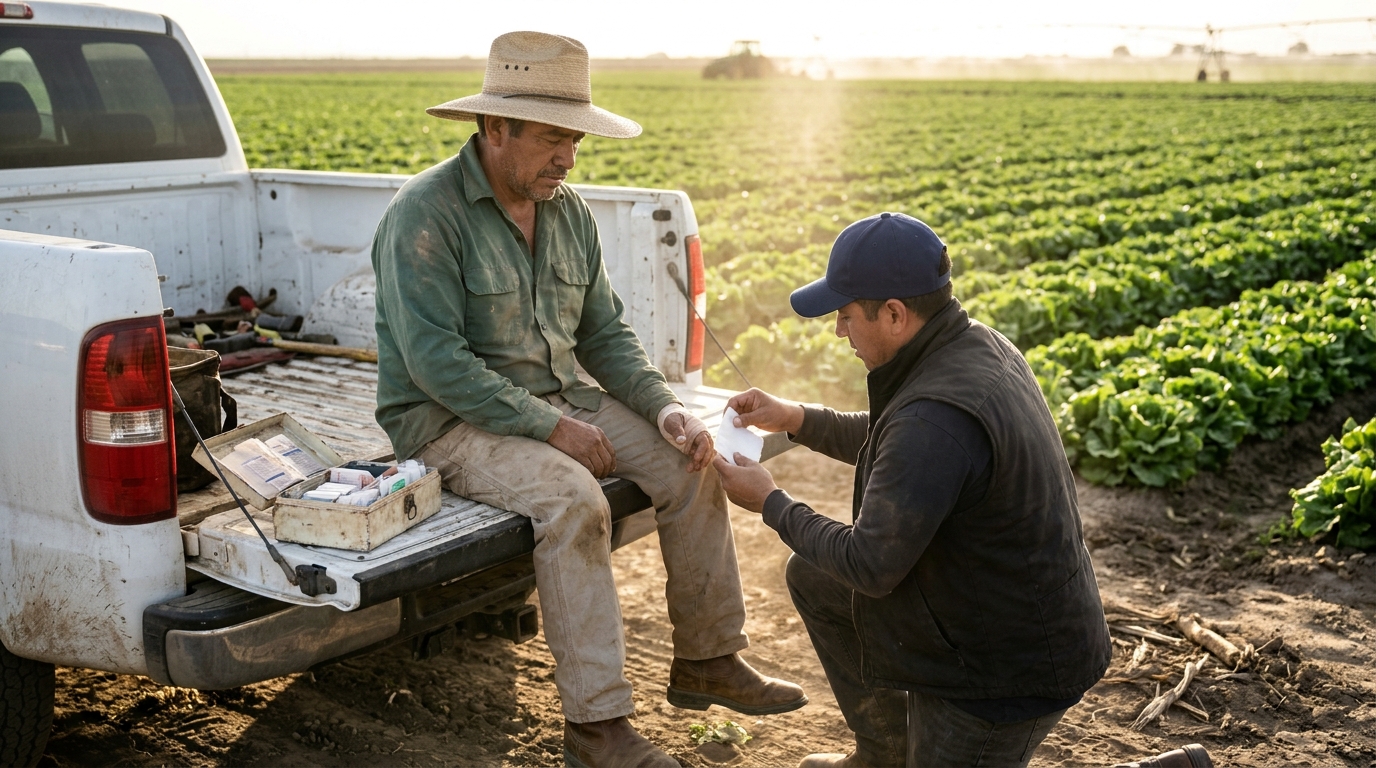
Workers’ compensation for farmworkers has no single national rule because each state’s workers’ compensation law decides who is covered. Florida requires a farmer to carry coverage once the farm has more than five regular employees or at least 12 other seasonal workers for labor lasting 30 days or more. Under H-2A compliance guidance from the U.S. Department of Labor, H-2A employers must provide workers’ compensation or an equivalent at no cost to workers, even where state law excludes farm labor.
Agriculture’s fatal-injury rate was 18.6 deaths per 100,000 full-time-equivalent workers in 2022, compared with 3.7 across all U.S. industries. Falls caused 29% of the 21,020 agricultural injuries requiring days away from work between 2021 and 2022, and NIOSH notes that these injuries are underreported.
Key Takeaways
- Workers’ compensation for farmworkers has no single national rule, so a worker must first confirm the rules of the state where the work happens.
- H-2A employers must provide workers’ compensation or an equivalent at no cost to workers in every state, even where state law excludes farm labor.
- Coverage thresholds vary by state: Pennsylvania exempts agricultural workers who work fewer than 30 days or earn less than $1,200 in a calendar year from one employer, while New Mexico requires agricultural employers with three or more employees to carry coverage.
- Farm workers should ask their employer in writing for the insurer’s name, policy number, and coverage date before the first day of work, because an Alabama farm that never elects coverage has no state-required policy.
- Agriculture recorded 18.6 deaths per 100,000 full-time-equivalent workers in 2022, compared with 3.7 across all U.S. industries, and agricultural injuries are underreported.
Why Farm Coverage Depends on the State Where You Work
Workers’ compensation for farmworkers has no single national rule. Each state’s workers’ compensation law decides whether farm labor is covered, and the approaches vary widely. Some states require coverage for farm employees in general, some exempt agricultural labor, and many apply thresholds based on headcount, time worked, or pay.
New York sits at the broad end. Farms that have employees must carry workers’ compensation insurance, and farm laborers supplied by a farm labor contractor are generally treated as employees of the farm owner or lessee. The state does exclude the farmer’s spouse and children under 18 unless they work under an express contract of hire, so family members are not automatically covered.
Other states leave the decision to the farm. In Alabama, employers of farm laborers are not required to carry workers’ compensation under state law, but they may choose to be covered. In Pennsylvania, agricultural workers are exempt if they work fewer than 30 days or earn less than $1,200 in a calendar year from one employer.
Thresholds can also depend on the size of the operation. Nebraska generally applies its Workers’ Compensation Act to an agricultural employer that has at least 10 unrelated, full-time employees on each working day for 13 calendar weeks in a year. New Mexico takes a different path, requiring agricultural employers with three or more employees to carry coverage and counting part-time and seasonal workers toward that number.
Because the answer changes from one state to the next, the first question is always where the work happens. The next questions are which category the worker falls into, such as seasonal, part-time, family member, H-2A, or supplied by a contractor. Coverage requirements, claims, and costs depend on both the state and the worker category.
Do State Laws Exempt Farm Labor?
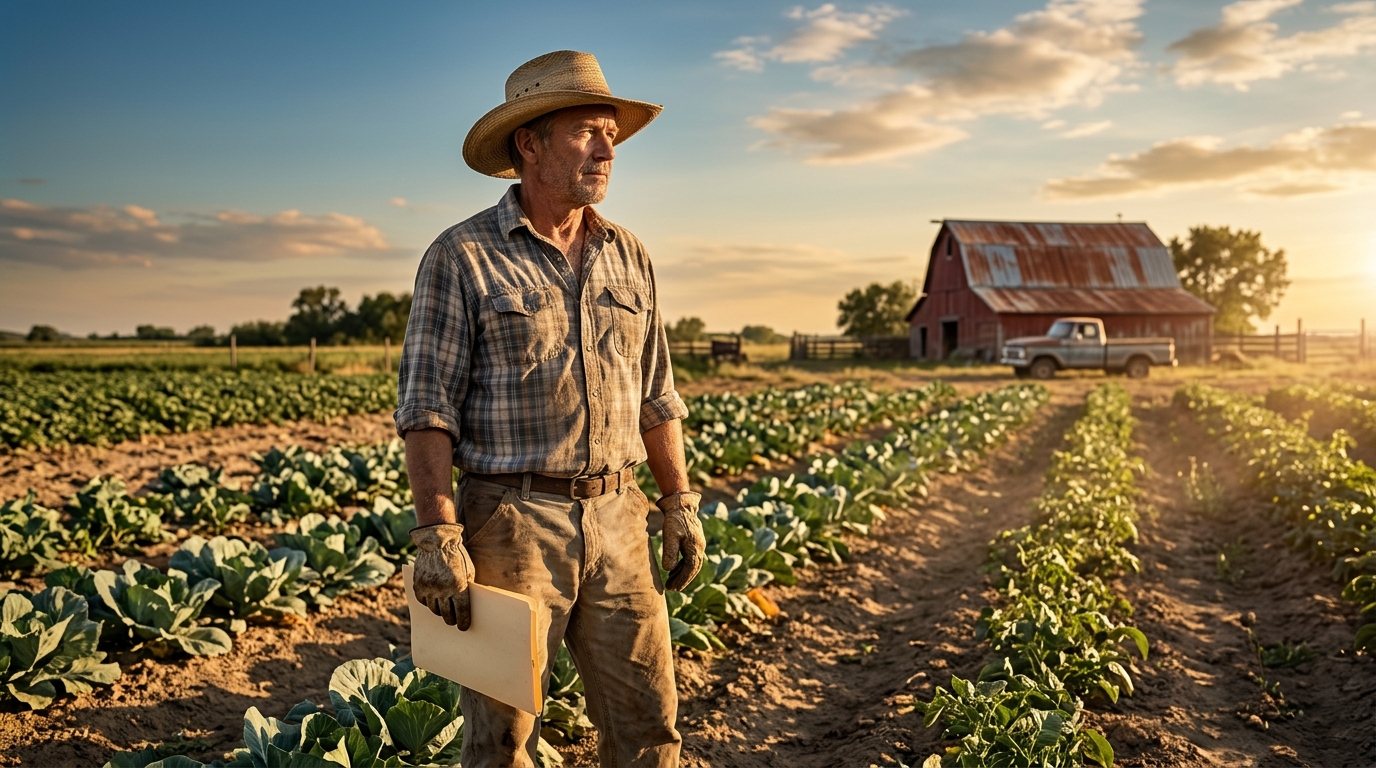
Some states exempt farm labor outright, some let employers decide whether to cover it, and some exempt only workers who fall below set limits. Because the exemption determines whether a worker has any state-required protection, the state and the worker’s category have to be checked together.
Alabama is the clearest case of optional coverage. Under the rules from the Alabama Department of Labor, employers of farm laborers are not required to provide workers’ compensation under state law, but they may elect to be covered. A farm that does not make that election leaves its workers without a state-required policy, so a worker there cannot assume one exists.
Pennsylvania uses earnings and time limits instead. Agricultural workers are exempt when they work fewer than 30 days or earn less than $1,200 in a calendar year from one employer, so meeting either test is enough. A seasonal picker who works 25 days for one grower falls under the exemption even if that picker earns more than $1,200 from the same grower.
New York takes the opposite approach. The New York State Workers’ Compensation Board requires coverage for farms that have employees, but a farmer’s spouse and children under 18 are not counted as employees unless they work under an express contract of hire. A child who helps with chores under no hiring arrangement is therefore treated differently from a child who has been formally hired for paid work.
Workers in these exempt categories may have no state-required coverage, including:
- Employees of an Alabama farm that has not elected to be covered
- Pennsylvania agricultural workers who work fewer than 30 days or earn less than $1,200 from one employer in a calendar year
- A New York farmer’s spouse or child under 18 who is not working under an express contract of hire
Because a worker in any of these groups may have no required policy, the practical step is to ask the employer directly whether a workers’ compensation policy is in force and whether it covers the specific job being performed.
Which Farm Workers Fall Below Coverage Thresholds?
A farm falls below a coverage threshold when its headcount, worker type, or length of employment stays under the number its state sets, so no state-required policy applies. Each state counts differently, and the same crew can trigger coverage in one state and not in another.
Florida splits its test by worker type. A farm with five or fewer regular employees must still carry coverage if it brings in at least 12 other seasonal agricultural workers for labor lasting 30 days or more. A farm with four year-round workers that hires 14 harvest crew members for six weeks would therefore need a policy, according to the Florida Department of Financial Services.
Nebraska counts only unrelated, full-time employees, and the number must be present on each working day. A farm with 10 full-time hands during a 10-week harvest stays below the line. If the same crew works through 13 calendar weeks, the Workers’ Compensation Act applies 30 days after the 13th week, a detail the Nebraska Workers’ Compensation Court lays out in its guidance.
New Mexico sets the lowest line. Agricultural employers with three or more employees must carry coverage, and part-time and seasonal workers count toward that number. The state’s workers’ compensation agency reports that a 2016 New Mexico Supreme Court ruling invalidated the agricultural-labor exclusion, so a farm with two full-time workers and one seasonal picker is already at the threshold, as the New Mexico Workers’ Compensation Administration explains.
Because Florida and Nebraska both measure by days or weeks, a farm should keep dated records of when each worker started, how many days or weeks each worked, and whether each one is regular, seasonal, part-time, or full-time. Without those records, an employer cannot show whether it crossed the line during a given season.
Does H-2A Coverage Apply in Every State?
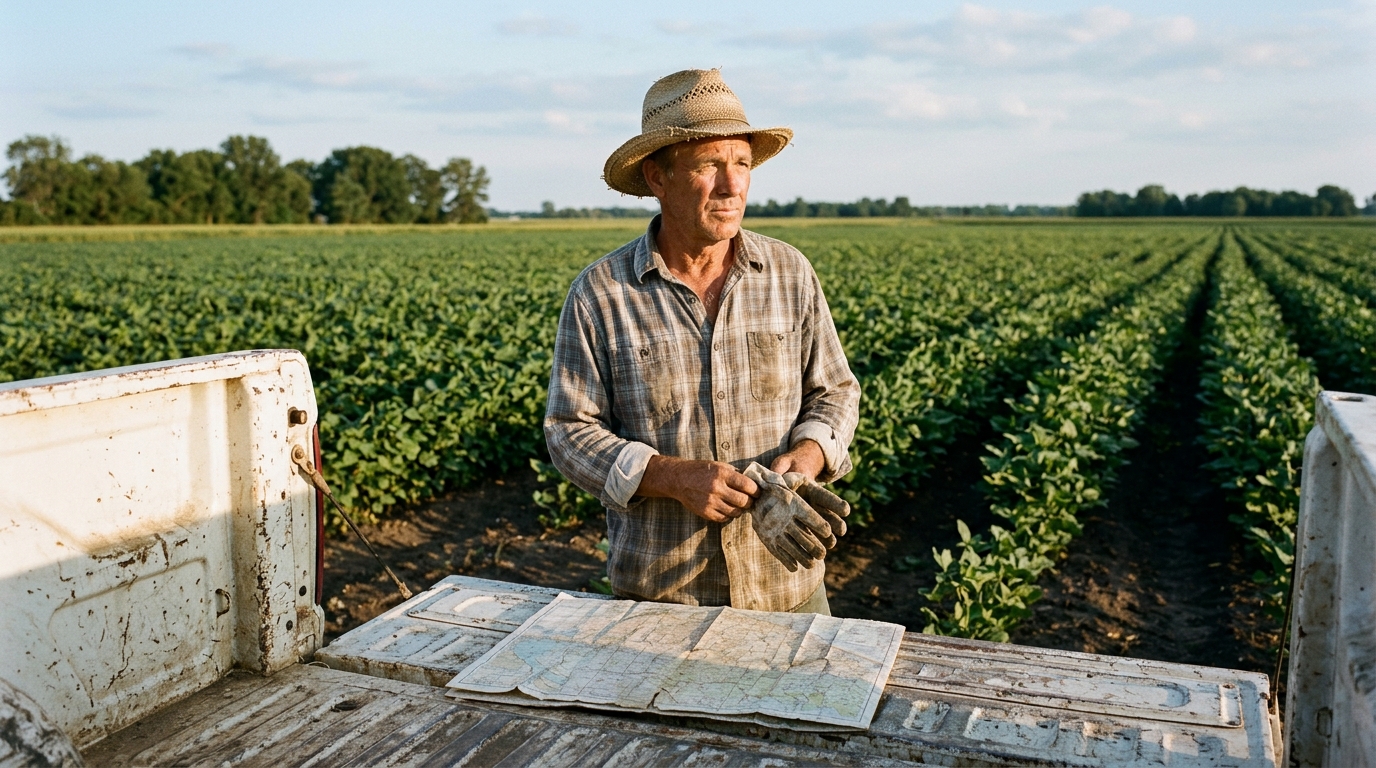
Yes. H-2A employers must provide workers’ compensation or an equivalent in every state, and the requirement still applies when state law excludes agricultural labor. Because the obligation comes from the federal H-2A program, a worker’s protection does not depend on whether the state where the farm sits requires coverage for that kind of work.
Alabama shows why this matters. State law there does not require farms to carry workers’ compensation for farm laborers, so an Alabama farm that never elects coverage has no state-required policy. An H-2A worker on that farm is still owed the federal coverage, because the state’s optional system does not remove the federal condition of the program.
The coverage must cost the worker nothing. An employer cannot meet the requirement by deducting the premium from wages or passing the expense on to the crew. Equivalent coverage may take a different form than a standard insurance policy, so a worker who is told about a plan should ask what it is, who administers it, and who pays for it.
H-2A workers should still check what their employer has in place rather than assume it. Ask for the name of the insurer or plan, the policy or coverage number, and whether the coverage applies to the specific tasks the worker performs, such as harvesting, packing, or operating equipment. Keep a copy of any written confirmation with the date it was given. If the answer is unclear, ask before the first shift, when the question is easier to resolve.
What Happens When a Labor Contractor Supplies Workers?
In New York, farm laborers recruited or supplied by a farm labor contractor are generally deemed employees of the farm owner or lessee, so the farm where the work happens is usually the employer for workers’ compensation purposes. The contractor may still recruit, pay, and transport the crew, but that does not usually change which party the state treats as the employer.
Many seasonal crews arrive through a contractor who handles hiring, paychecks, and moves between jobs. A picker hired by a contractor and sent to an orchard that a grower leases from a landowner may find that the lessee, not the contractor, is the party that matters for coverage. A name on a paycheck therefore does not reliably identify the employer.
State rules can affect who counts as the employer in contractor arrangements, and New York’s approach is not the only one. Another state may name the contractor as the employer, treat the contractor and the farm as joint employers, or set its own thresholds that determine whether either party must carry a policy. The same crew can be covered under one arrangement in one state and under a different arrangement across the state line.
Before any injury happens, a worker should write down three things: the farm where the work will be done, the contractor that supplied the crew, and the insurer that covers the job. Record the farm’s legal name and address, the contractor’s name and phone number, and the insurer’s name and policy number if the paperwork lists them. Ask which party appears as the employer on the hiring documents, and keep copies.
Because the rules differ by state, the local law should be checked before relying on any of these answers. A worker who moves from one state to another for the next harvest should not assume the employer rule carries over.
How Common Are Farm Injuries and What Do They Cost?
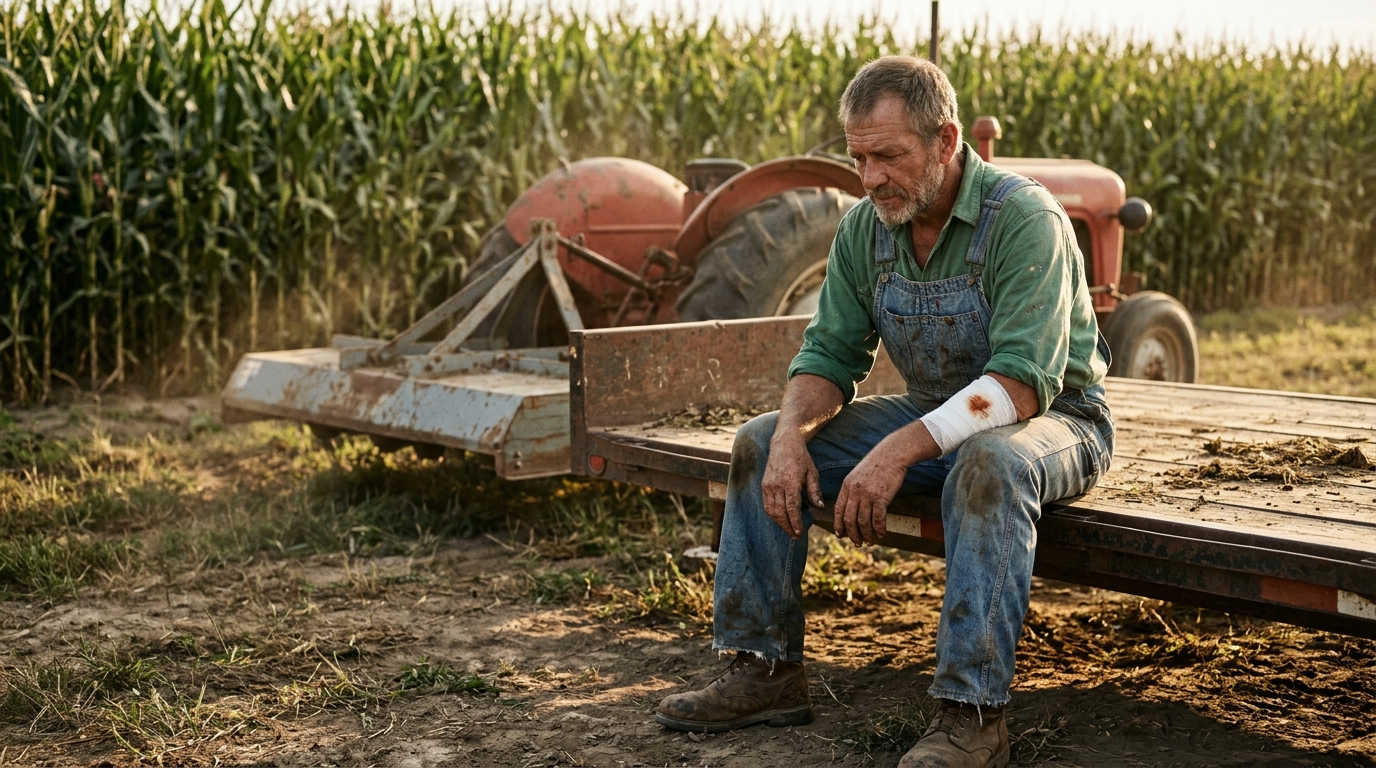
Farm injuries are frequent, serious, and expensive. Between 2021 and 2022, agricultural production had 21,020 injuries that required days away from work, and falls caused 29% of them. Falls from ladders, trucks, and elevated platforms are a recurring hazard on farms, which is why they account for such a large share of injury cases.
Fatal injuries are an even greater concern. In 2022, agriculture, forestry, fishing, and hunting recorded 18.6 deaths per 100,000 full-time-equivalent workers, compared with 3.7 across all U.S. industries, roughly five times the rate for the whole economy.
The official counts probably understate the problem, because agricultural injuries are underreported and many cases never appear in the numbers.
The cost picture is also large. A 2024 study in the American Journal of Industrial Medicine estimated annual U.S. agricultural injury costs at $11.31 billion in March 2024 dollars, including costs tied to self-employed farmers and hired workers. That figure is an injury-cost estimate, not an insurance premium. For each nonfatal agricultural injury, the same study put average costs at $10,878 for medical care and $4,735 for lost work time, or $15,613 in total.
Those averages show why the coverage rules in each state matter. A worker who is hurt and cannot work faces both the medical bill and the lost wages, and a farm’s own premium depends on its state, headcount, and payroll rather than on national totals.
Checking Your Coverage Before an Injury Happens
Start with the paperwork before the first day of work. Ask the farm or the labor contractor for the insurer’s name, the policy number, and the date coverage took effect. Write the answers down with the date you asked, and if the answer is spoken rather than written, request written confirmation.
Then check the rule for the state where the work happens. A Pennsylvania worker expecting 25 days with one grower should track both the 30-day test and the $1,200 earnings test, since either one can trigger the exemption. A Florida crew member should ask how many regular employees the farm has and how many seasonal workers it brings in for labor lasting 30 days or more.
If you are working under H-2A, confirm that the coverage costs you nothing and that it applies to your actual tasks, such as harvesting, packing, or running equipment. If the farm offers an equivalent plan instead of a standard policy, ask who administers it and who pays the premium or plan cost.
Keep one folder with the farm’s legal name and address, the contractor’s phone number, the insurer’s details, and every written confirmation. If you are injured and cannot name a policy, report the injury to your employer in writing that day, keep a copy, and contact your state’s workers’ compensation agency for guidance on your options.