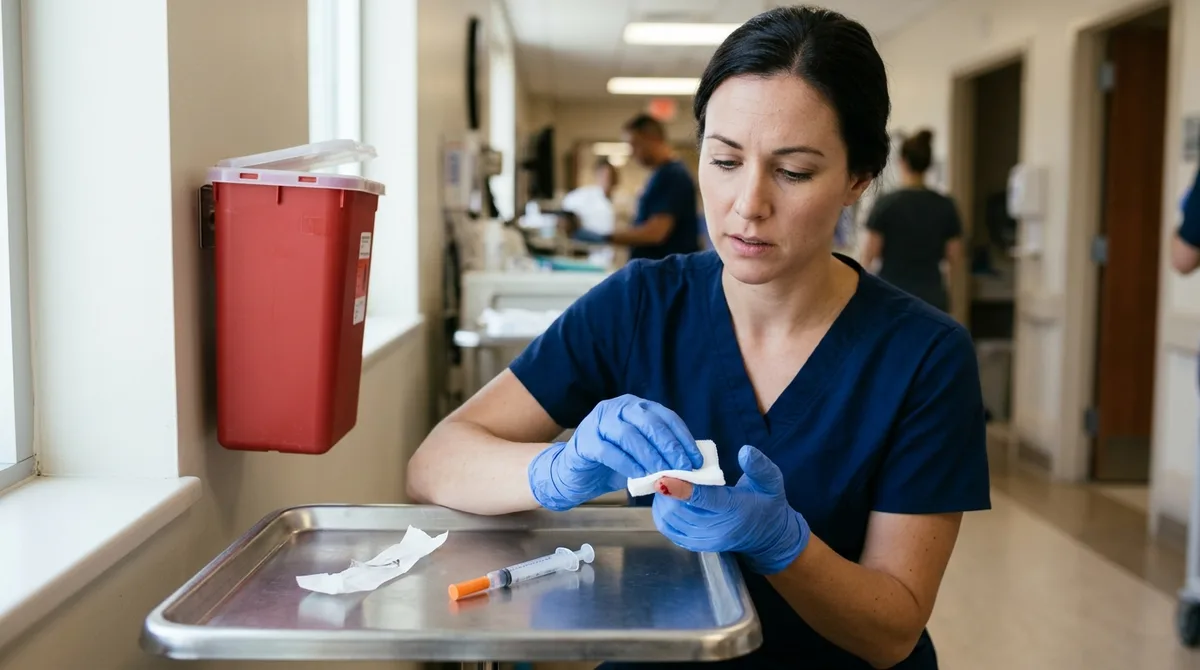
Workers’ comp needlestick injuries involve two things at once: a workplace injury and a possible bloodborne-pathogen exposure, so the first steps should happen together. Under the OSHA Bloodborne Pathogens standard, an employer must make a confidential medical evaluation and follow-up immediately available after a reported exposure incident, at no cost to the employee.
Hospital-based healthcare personnel sustain roughly 385,000 needlesticks and other sharps-related injuries each year, so this is a common hazard that calls for fast action. HIV post-exposure prophylaxis should start as soon as possible, and no later than 72 hours after exposure. Baseline hepatitis C testing is recommended, preferably within 48 hours. Report the injury right away, note the device involved and the time, and ask for the medical evaluation in writing.
Key Takeaways
- Employers must record work-related needlestick injuries on the OSHA 300 Log without naming the injured employee.
- Hepatitis C monitoring requires an HCV RNA test at 3 to 6 weeks, followed by a final anti-HCV test at 4 to 6 months.
- Reporting deadlines vary by state, as California’s warning about losing benefits after 30 days shows.
- Needlestick denials often turn on whether the exposure happened at work, whether it was reported on time, or whether treatment is connected.
- Track every visit, test, and prescription in one dated log, because that record answers any questioned bill or missed follow-up.
What Should You Do Right After a Needlestick at Work?
An exposure incident is a specific kind of contact that triggers the federal bloodborne-pathogen rules. It means eye, mouth, mucous-membrane, non-intact skin, or parenteral contact with blood or other potentially infectious materials that results from your work duties. A needlestick from a sharp contaminated with blood usually meets that definition when it happens while you are doing your job. That means you face two obligations at once: the exposure response and the workers’ compensation injury.
Under 29 CFR 1910.1030, your employer must make a confidential medical evaluation and follow-up immediately available after a reported exposure incident. That care is provided at no cost to you and includes post-exposure prophylaxis when it is medically indicated. Your employer’s obligation depends on the report, so the report is what opens that path.
Handle both tracks on the same day, in this order:
- Wash the wound with soap and water, or flush a splash to the eyes or mouth with clean water, without scrubbing hard enough to cause more bleeding.
- Tell your supervisor right away, giving the time, the location, and the device involved.
- Ask for the post-exposure evaluation process in writing, including where to go and who will see you.
- Attend the confidential medical evaluation the same day, because the testing and prophylaxis timelines begin at the exposure.
- Start the workers’ compensation report with your employer as a separate step from the medical visit, so the injury is documented from the first day.
- Request a copy of the evaluating professional’s written opinion, which your employer must give you within 15 days after the evaluation is complete.
Write down the names of the people you spoke with and the times of each conversation while the details are fresh.
What Bloodborne Pathogen Testing Follows a Needlestick?
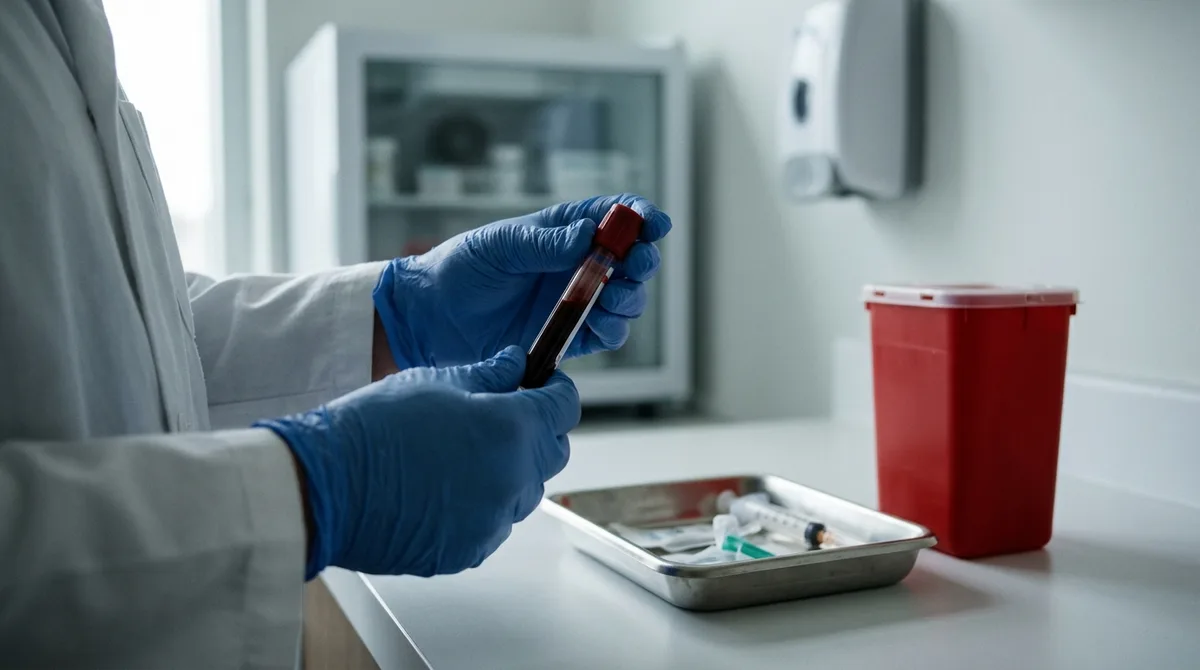
Bloodborne pathogen testing after a needlestick runs on two clocks. HIV post-exposure prophylaxis (PEP) should start as soon as possible, and no later than 72 hours after exposure, while hepatitis C testing begins with a baseline test. The 2025 U.S. Public Health Service occupational HIV guidelines set the HIV timeline and prescribe PEP for 28 days.
The same guidelines estimate an average HIV transmission risk of 0.23% after a percutaneous exposure to HIV-infected blood, based on prospective studies of healthcare personnel. A single average does not describe any one injury, which is why the evaluating clinician needs the details of your exposure, including the source and the device, before deciding on treatment.
The 2025 guidelines introduced new PEP regimen recommendations, shortened the duration of follow-up HIV testing, and eliminated routine laboratory tests for antiretroviral drug toxicity. They also added guidance for exposures to sources with undetectable viral loads. Ask your clinician which version of the guidance they are following, and ask how it applies to your source.
Hepatitis C follows a different schedule. The CDC’s hepatitis C guidance for healthcare personnel recommends baseline testing as soon as possible, preferably within 48 hours. When follow-up is indicated, the sequence is:
- Baseline hepatitis C test, preferably within 48 hours of exposure
- HCV RNA test at 3 to 6 weeks
- Final anti-HCV test at 4 to 6 months
CDC does not recommend hepatitis C post-exposure prophylaxis, so the hepatitis C path consists of testing and monitoring rather than medication. Mark each date on your calendar as soon as the clinic gives you the schedule. The later tests may fall months after the injury and after your first claim paperwork is filed.
Federal rules also require the employer to give you a copy of the evaluating healthcare professional’s written opinion within 15 days after the evaluation is completed. Request that copy in writing, and keep it with your claim papers, along with the date of each test and each medical visit.
Is a Needlestick Recorded as a Work Injury?
Yes. Under the OSHA recordkeeping rule, 29 CFR 1904.8, employers must record work-related needlestick injuries and cuts from sharps contaminated with another person’s blood or other potentially infectious material on the OSHA 300 Log. The entry does not include the employee’s name, so the injury appears in the employer’s records without the worker being identified on that form.
That log entry matters for your claim because it places the injury in the employer’s own records. Pair it with the written incident report, the sharps log entry, and the date and task you were performing when the needlestick happened. Together, these records show the injury arose from your work duties. Write down the device, your department, and the procedure you were doing, and ask for a copy of the incident report once it is completed.
Employers covered by the bloodborne pathogens standard have ongoing duties too. Under 29 CFR 1910.1030, they must review and update the written Exposure Control Plan at least once a year, and they must document that they considered and implemented appropriate, commercially available, effective safer medical devices. These requirements have a short history. The Needlestick Safety and Prevention Act was signed on November 6, 2000, and OSHA’s revised Bloodborne Pathogens standard took effect on April 18, 2001. That revision added requirements on safer devices, worker input, and sharps-injury logs.
Worker input is worth using. If you were injured by a device your team has raised concerns about, say so in your report, and ask whether the device has been reviewed since the last Exposure Control Plan update. Keep a copy of anything you sign.
How Do Claim Deadlines Vary Across States?

Deadlines and claim-form rules differ from state to state, so you need to check the rules where you work. California is a useful example of how short these windows can be, but its figures are not a national standard.
In California, the Division of Workers’ Compensation tells injured workers to report a work injury promptly. It also warns that failing to report within 30 days could result in losing workers’ compensation benefits. Because a needlestick can produce bloodborne-pathogen testing months later, a delay in reporting the injury itself can leave a gap in your records.
The employer also has a clock in California. Under the state’s rules, an employer must give or mail a workers’ compensation claim form within one working day after learning of an injury or illness. Once the claim form is filed, the employer must authorize appropriate medical treatment within one day, up to $10,000, while it decides whether to accept or reject the claim.
Reporting to your employer and filing a formal claim are separate steps. Telling your supervisor about the device, the time, and the location is the report. The claim form is the paperwork that starts the benefits process, and each step can carry its own deadline. Treat them as two tasks, and write down the date you completed each one.
To find the rules that apply to you, identify your state’s workers’ compensation agency and look up its reporting window, its claim-form requirements, and any timelines for medical treatment. Ask your employer for the claim form in writing and note the date you received it. Add those dates to the calendar you started for your hepatitis C tests, so the reporting deadline and the testing schedule are in one place.
Who Pays for Needlestick Treatment and Lost Wages?
Once a needlestick claim is accepted, medical treatment is generally authorized through the workers’ compensation system, while wage replacement depends on your state and on whether a clinician finds that time away from work is medically required. These are separate questions, and each follows its own process.
Before you schedule a referral, lab test, or prescription, ask who must approve it under the claim. Track every visit, test, and prescription in one log with the date, the provider, and what was done. That log becomes your record if a bill is questioned or a follow-up test is missed.
Costs are easy to underestimate. A 2005 study of acute-care nurses treating patients with diabetes estimated short-term costs of $145 to $201 per needlestick injury, including post-exposure testing, healthcare services, prophylaxis, and indirect costs. That figure is historical and specific to that study, so it is not a current price for your treatment. Your actual costs depend on the tests and medications your clinician orders.
Disability benefits may apply if your doctor restricts your work or takes you off duty. The rules differ by state, so check how your state calculates wage replacement and what paperwork it requires. Ask your clinician to document in writing whether time away is medically required and for which dates.
Keep these records with your claim papers:
- Work schedules showing the shifts you were assigned and the shifts you missed
- Pay stubs from before and after the injury
- Medical notes stating any work restrictions or time off
Why Needlestick Claims Get Denied and How to Appeal

Needlestick claims that get questioned usually turn on three disputes. The first is whether the exposure happened at work, so the task, department, and device should be recorded when the injury occurs. The second is whether the injury was reported on time, since a late report can leave a gap in the record. The third is whether the testing or treatment is medically connected to that exposure, which can be harder to show when follow-up tests fall months later.
Gaps in the written incident report or the sharps log make these disputes harder to resolve. If the log omits the device or the shift, or the report does not name the procedure you were performing, the claim has less support on paper.
A denial letter usually states the reason for the decision and the next steps. Appeal steps and deadlines vary by state, so the deadline in your letter and your state’s rules set your timing.
Keeping a dated timeline helps any appeal. Record each report, medical visit, test, and employer response with the date and the name of the person involved. If your claim is denied, the appeal generally follows these steps, though the exact forms and order depend on your state:
- Read the denial letter and mark the stated reason and the appeal deadline on your calendar.
- Request your complete claim file and the written incident report in writing.
- Ask your evaluating clinician for a written note explaining how each test or treatment relates to the exposure.
- Compare your timeline with the incident report and sharps log, and list any missing or conflicting details.
- File the appeal using the form or channel the letter or your state agency specifies, and keep proof of the filing date.
When to Bring in a Workers Comp Attorney
This publication explains how workers’ compensation generally works, but it cannot review the details of your own claim. If your situation raises the questions below, contact a licensed attorney in your area who handles workers’ compensation cases.
A denial is the clearest reason to seek advice, especially if the letter cites a reason you do not understand or disputes whether the exposure happened at work. Disagreements over medical treatment or wage benefits also justify a consultation, because approval rules and wage calculations differ from one claim to the next.
Any settlement offer deserves a review before you respond. Settlement value depends on the facts of your injury, including follow-up testing that may not finish for months, and on the rules of your state. An offer that looks fair at the start may not account for those later tests or for any treatment still ahead.
If you are considering a lawsuit against your employer, ask an attorney about exclusive-remedy limits before you take any other step. Workers’ compensation often limits a worker’s right to sue an employer over a work injury, so whether a suit is possible in your state should be answered first.
Bring your dated timeline, the denial letter or settlement paperwork, the written incident report, and your medical notes to that meeting. Those records give an attorney the facts needed to start the discussion.
Next Steps for Protecting Your Needlestick Claim
Start with one task this week: build a single incident file. On one page, write the exposure date and time, the device involved, the unit or department, and the procedure you were performing. Next to each conversation, record the name and job title of every supervisor, occupational health staff member, and clinician you spoke with, along with the time of the call.
Then call the clinic that evaluated you and ask them to confirm your hepatitis C test dates in writing, including the baseline test and the follow-up tests at 3 to 6 weeks and 4 to 6 months. Save that letter or email in the same file.
Next, ask your employer for a copy of the sharps-injury log entry for your injury. Check whether the device, the shift, and the date match your notes. If anything differs, send a written correction request to your supervisor and keep a dated copy.
Finally, find your state’s workers’ compensation agency and note its reporting deadline and claim-form rules beside your testing schedule. If you receive a denial, a dispute over treatment, or a settlement offer, bring the file to a licensed workers’ compensation attorney in your area before you respond.
Frequently Asked Questions
1. Can I still file a claim if I did not report the needlestick the same day?
A late report does not automatically end a workers’ compensation claim, but it can weaken your position and narrow your options. Reporting windows vary by state, and California’s 30-day warning is only one example of how short those deadlines can be. Report as soon as you can, and write down the reason for any delay, such as being sent for emergency testing first, so the timeline is clear.
2. Does workers’ compensation pay for hepatitis and HIV testing if the source patient’s status is unknown?
Testing ordered after a reported exposure is generally part of the no-cost evaluation that OSHA requires your employer to make available, and an unknown source status does not remove that obligation. Ask the clinic which tests are being billed to your claim and whether any are being billed to your own insurance. Keep copies of every bill and explanation of benefits so you can check them against your test schedule.
3. Can I choose my own doctor for post-exposure follow-up?
Whether you can choose your own doctor depends on your state’s rules and on how your employer’s claim process authorizes providers, so there is no single answer. Ask your employer in writing who must approve any provider you want to use and whether that provider will be paid under the claim. Keep the evaluation and any follow-up tests on schedule while that approval is pending, because the testing timeline does not pause for paperwork.
4. Who files the claim if I am a temporary or contract healthcare worker?
The claim is usually handled by the employer that pays your wages, which is often a staffing agency, although the facility where you were injured may also be involved. Some states allow more than one party to be considered the employer, so coverage can be disputed. Report the injury to both the agency and the facility in writing, and consult a licensed workers’ compensation attorney in your area if the carrier disputes which one covers you.
5. What should I do if my employer says the needlestick was not work-related?
Keep pursuing the post-exposure evaluation, because your employer’s duty to provide it follows from the reported exposure incident and does not wait for the work-related question to be settled. Put your report, the device, the time, the location, and your task in writing, and ask your employer to confirm in writing whether the injury was recorded. If the employer refuses to accept the report, ask for that refusal in writing and bring it, along with your dated timeline, to a licensed attorney in your area.