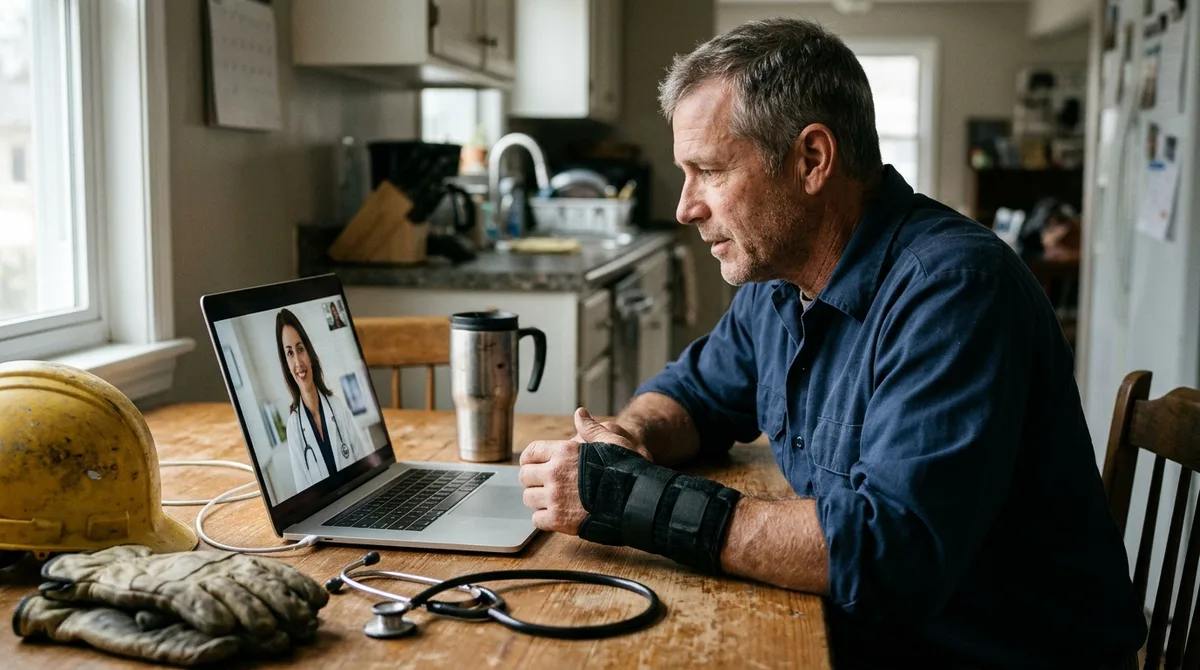
Workers’ comp telemedicine rules are set by each state, so whether a remote visit is allowed for your claim depends on where you are being treated. New York’s permanent telehealth rule, effective July 11, 2023, requires physicians, podiatrists, nurse practitioners, and physician assistants to see a worker in person for the initial visit. Texas allows telemedicine to certify maximum medical improvement only in narrow cases, such as a minor injury that needs no further treatment and causes no impairment. Workers across the United States should check their own state’s rules before scheduling a remote visit.
Key Takeaways
- Texas’s maximum medical improvement telemedicine option requires the worker’s consent, so an unwilling worker cannot be examined remotely under it.
- Under federal FECA guidance, routine care for accepted conditions may be delivered by telemedicine without telehealth-specific preauthorization.
- Telehealth billing codes must describe the visit actually delivered, so a video visit never carries the audio-only modifier 93.
- A remote visit in New York does not satisfy the required in-person visit schedule, so telehealth adds to records without replacing face-to-face care.
How Do Telemedicine Rules Differ by State?
Each state sets its own telemedicine rules for workers’ compensation, so a remote visit allowed in one state may be barred in another. States may limit which providers and appointment types qualify, require in-person visits at set intervals, and prescribe the billing codes providers must use.
New York’s permanent rule shows how a definition shapes everything that follows. It treats telehealth as care from specified Board-authorized clinicians using two-way audio and video or audio only, when medically appropriate.
Texas draws its line by the type of clinician. Under Texas Department of Insurance rules, telemedicine provided by a Texas-licensed physician is treated differently from telehealth provided by other health professionals, and payment is tied to Medicare policies and Texas workers’ compensation rules.
Because each state draws these lines differently, the New York and Texas examples do not add up to a single national standard.
Which Injuries and Visits Qualify for Telehealth?
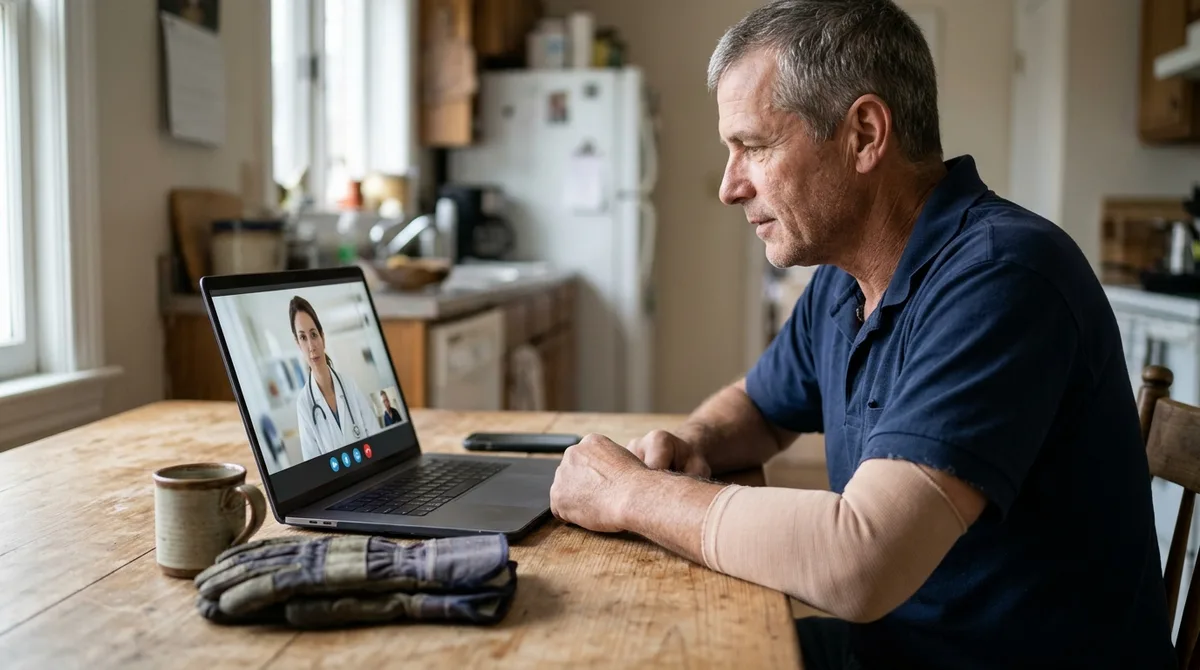
Telehealth qualifies only when it is medically appropriate and consistent with each state’s restrictions. In New York, psychologists and licensed clinical social workers may use telehealth from the first visit, but they must document the reason for each remote visit when in-person care would add no benefit or would pose undue risk or hardship. Chiropractors, acupuncturists, physical therapists, and occupational therapists cannot provide workers’ compensation treatment by telehealth under New York’s permanent rule. Texas takes a narrower route. Under amended 28 Texas Administrative Code §133.30, a treating doctor may certify maximum medical improvement by telemedicine only if the worker was previously examined for that condition, consents, and has a minor injury that needs no further treatment and causes no impairment. Remote impairment-rating examinations remain excluded. A video or audio visit cannot fully replace a hands-on examination. Injuries that require palpation or physical testing typically need in-person care, and a minor injury that still needs treatment falls outside the Texas option.
Can You Refuse Telehealth or Request an In-Person Visit?
Whether you can refuse a telehealth visit depends on your state, and in some places your consent is a condition of the rule. Texas’s maximum medical improvement telemedicine option, for example, requires the worker’s consent, so a worker who does not agree cannot be examined remotely under that option. In New York, physicians, podiatrists, nurse practitioners, and physician assistants must see a worker in person for the initial visit, at least every third visit during the first three months, at least every three months for chronic conditions, and at least annually for chronic conditions at maximum medical improvement.
To request an in-person visit, raise it with your treating provider first and ask that the request be noted in your chart. Then send the same request in writing to the claims administrator, which handles authorizations. Keep copies of each request, the date you sent it, and any reply you receive.
Choice of physician forms may list providers who offer telehealth, so check how a provider delivers visits before you select them.
Who Approves Remote Visits and Why Requests Get Denied

Approval works on two levels. One question is whether the telehealth visit itself needs advance approval. The other is whether the treatment delivered during that visit needs authorization. The federal Federal Employees’ Compensation Act shows the difference. Under U.S. Department of Labor guidance, authorized providers may deliver routine medical care related to accepted conditions by telemedicine without a telehealth-specific preauthorization. Services that otherwise require authorization still need it.
New York applies a similar logic to payment. A payer disputing an otherwise permitted telehealth visit generally cannot refuse payment solely because care was delivered remotely, unless the visit type is expressly prohibited. A payer that wants an in-person exam instead may ask the Board for direction on a future in-person visit using Form RFA-2, box K.
What Documentation and Billing Codes Providers Must Use
Telehealth bills need more than a visit date and a fee. For federal FECA claims, the Department of Labor’s telemedicine guidelines require appointment notes with the bill that identify:
- the telemedicine method used
- the length of the visit
- the information collected during the visit
- the need for the appointment and the benefit it provided
New York’s billing guidance for eligible physicians, podiatrists, nurse practitioners, and physician assistants uses a fixed set of codes. The visit is billed as E/M code 99212. Modifier 95 marks an audio-video visit, and modifier 93 marks an audio-only visit. Place-of-service code 10 applies when the patient is at home, and code 02 applies when the patient is elsewhere in a healthcare setting.
The codes describe what actually happened, so they must match the visit delivered. A video visit billed with the audio-only modifier, or a home visit billed with the wrong place-of-service code, leaves the claim out of step with the medical record.
How Fee Schedules and Out-of-State Billing Affect Payment

New Mexico’s workers’ compensation fee schedule, effective January 1, 2026, directs providers to bill telehealth under codes 98008 through 98015 instead of E/M codes 99202 through 99215. Those telehealth codes carry maximum payments equal to the in-person E/M rates.
Texas permits payment for certain services regardless of where the injured worker is located. Billing still follows applicable Medicare payment policies and Texas workers’ compensation rules.
Telemedicine use grew sharply during the pandemic. A Workers’ Compensation Research Institute study of 28 states, representing 79% of nationwide workers’ compensation benefits, found telemedicine made up 10.2% of evaluation-and-management services in 2020 Q2, up from 0.2% in 2019 Q4. Pricing also varied: in 2020, telemedicine prices for established-patient code 99213 were within 10% of in-person prices in 24 states, and 12% to 18% lower in the other four.
When treatment takes place across a state line, the key question is which state’s fee schedule and billing rules apply. Confirm that before the appointment.
Checking Your State’s Telemedicine Rules Before Your Next Visit
Start by finding your state’s workers’ compensation agency website and locating its telemedicine rule, including the date it took effect. Confirm whether your provider’s license type is covered and whether your visit type is allowed. In New York, the rule is codified at 12 NYCRR 325-1.26, so you can check whether your provider is a physician, podiatrist, nurse practitioner, or physician assistant.
Before your next appointment, call the provider’s office and ask two questions: will the visit be in person or remote, and does that visit type need authorization from the claims administrator? Write down the answers, the date, and the name of the staff member you spoke with.
If the visit is remote and you want an in-person exam, put that request in writing to the claims administrator and keep a dated copy.
Frequently Asked Questions
1. Do I need a copy of my telehealth visit notes for my own records?
Yes, keeping a copy of each telehealth visit note is a sensible habit for an injured worker. The note records the reason for the visit, what the provider collected, and the plan for further care, which can matter if the claims administrator later questions a request or a bill. Ask the provider’s office for the note after each remote visit, and check that it states whether the visit was by audio, by video, or in person.
2. What should I do if my doctor stops offering video visits partway through treatment?
Ask the provider in writing whether remote visits are still available and whether your next appointment must take place in person. If you need an in-person appointment, send that request to the claims administrator and note the date you sent it. Keep the provider’s reply with your other claim records so you can show when the change happened.
3. How can I tell whether my provider is licensed to deliver telehealth in my state?
Start by confirming that your provider holds a current license in the state where you are being treated, using that state’s licensing board lookup. Then check whether your provider’s license type is among those your state’s workers’ compensation telemedicine rule covers. A valid license alone does not qualify a provider to deliver remote workers’ compensation care.
4. Does a telehealth visit count toward a state’s required in-person visit schedule?
No. In New York, a remote visit does not satisfy the in-person requirements for the initial visit or for the scheduled in-person visits that follow. Those requirements call for the provider to see the worker face to face at set points in treatment. A video or audio visit adds to the care record but does not replace one of the required in-person appointments.