
Rules differ by state. Florida, for example, covers recreational or social activities only when they are an expressly required incident of employment that produces a substantial direct benefit beyond the usual improvement in employee health and morale.
Location and voluntary participation can change the result. Under Illinois Workers’ Compensation Act § 11, injuries during voluntary recreational programs, including parties and picnics, are excluded even when the employer pays some or all of the cost. That exclusion does not apply when the employee was ordered or assigned to take part.
Key Takeaways
- Employer sponsorship or funding alone does not make an injury at a company event compensable. New York, for example, requires that the injury both arise out of and occur in the course of employment.
- Whether attendance was required or expected is a central factor: a North Carolina court upheld coverage for a required conference, while a Virginia commission denied benefits to a Frito-Lay employee hurt at a voluntary, off-duty basketball tournament.
- Florida covers recreational or social activities only when an employer expressly requires them and they produce a substantial direct benefit beyond the usual improvement in employee health and morale under Florida Statutes § 440.092(1).
- Injured workers in Texas generally must report the injury to the employer within 30 days and file a claim with the Division of Workers’ Compensation within one year, while Delaware employers must submit a First Report of Occupational Injury or Disease within 10 days after being notified.
- Injured workers should consult a licensed workers’ compensation attorney about a separate claim against a venue, caterer, or equipment provider, because a waiver signed before a recreational event may not control workers’ compensation rights.
Does Employer Sponsorship Make an Event Work-Related?
No, employer sponsorship or funding alone does not decide whether an injury at a company event is compensable. Decision-makers look at whether the injury arose out of employment and occurred in the course of employment. New York requires both.
New York applies this rule directly. A compensable injury there must arise both out of and in the course of employment, as a 2024 New York appellate decision confirmed. A worker must therefore show a connection to the job and a link to the time and circumstances of the work.
Decision-makers look closely at who controlled the event and who gained from it. In Holliday v. Tropical Nut & Fruit Co., the North Carolina Court of Appeals upheld compensability where the employer required attendance at a conference, encouraged employees to join a laser tag activity, and received business and networking benefits from the gathering. A party that the company merely paid for, with no expectation that employees attend and no business purpose, presents a much weaker case.
The exact test and its wording vary by state. Some statutes spell out the elements, while others rely on decades of court decisions that interpret them. As a result, a gathering that qualifies in one state may fall outside coverage in another, even when the facts look nearly identical.
Was Attendance Required or Just Optional?

Attendance matters because an event that employees are required or expected to attend is more closely tied to the job than one they can freely skip. Decision-makers ask whether the employer ordered or expected the employee to be there, or whether the employee was free to decide.
In the North Carolina conference case, the employer required attendance at a conference, encouraged staff to join a laser tag activity, and gained business and networking value from the gathering. Because attendance was expected, the court upheld compensability.
A different result came in Virginia. In a March 2025 report on a Virginia Workers’ Compensation Commission decision, a Frito-Lay employee injured an Achilles tendon at an off-duty, off-premises basketball tournament. Benefits were denied because participation was voluntary and the employer did not require or expect it.
Illinois draws a similar line. Its law excludes injuries during voluntary recreational programs, including parties and picnics, but the exclusion does not apply when the employee was ordered or assigned to take part. An employee assigned to staff the company picnic’s grill stands in a very different position from a colleague who chose to stop by for an hour.
Pressure can matter even without a written rule. A supervisor who tells the team that everyone is expected at the after-party, or who notices and comments on who showed up, may change how the event is viewed. Invitations, manager emails, and sign-in sheets are the kinds of records that show what was really expected.
Paid Time, Job Duties, and Location Matter
Being on the clock during a company event is one of the strongest signals that the gathering is tied to work. If an employer pays regular wages for the time spent at a party, picnic, or off-site outing, the employee is in a better position to argue that the injury happened in the course of employment. Timesheets and paystubs covering the event hours are useful evidence.
Assigned job duties strengthen that link. An employee who greets guests at the door, sets up tables, or runs the sound system or grill is performing a task the employer gave, not simply enjoying a social hour. The same is true when a manager asks someone to drive equipment to the venue. The more clearly the tasks came from the employer, the easier it is to show that the injury arose out of the job.
Location also matters. An event held on company premises during working hours is generally easier to connect to work than one held at a restaurant or rented venue across town. Off-site events can change the travel risks a worker faces, and that change is part of the analysis.
Travel is often treated differently from an ordinary commute. In Matter v. Google Inc., an account executive was struck by motorized bicycles while walking to a bus stop after a Google Cloud business-partner happy hour. The New York Appellate Division found the injury compensable, citing the employer’s business benefit and the event-related change in his travel risks. A trip home from a required event may therefore be viewed differently from a personal commute.
How Do Recreational Activities and Alcohol Affect Claims?
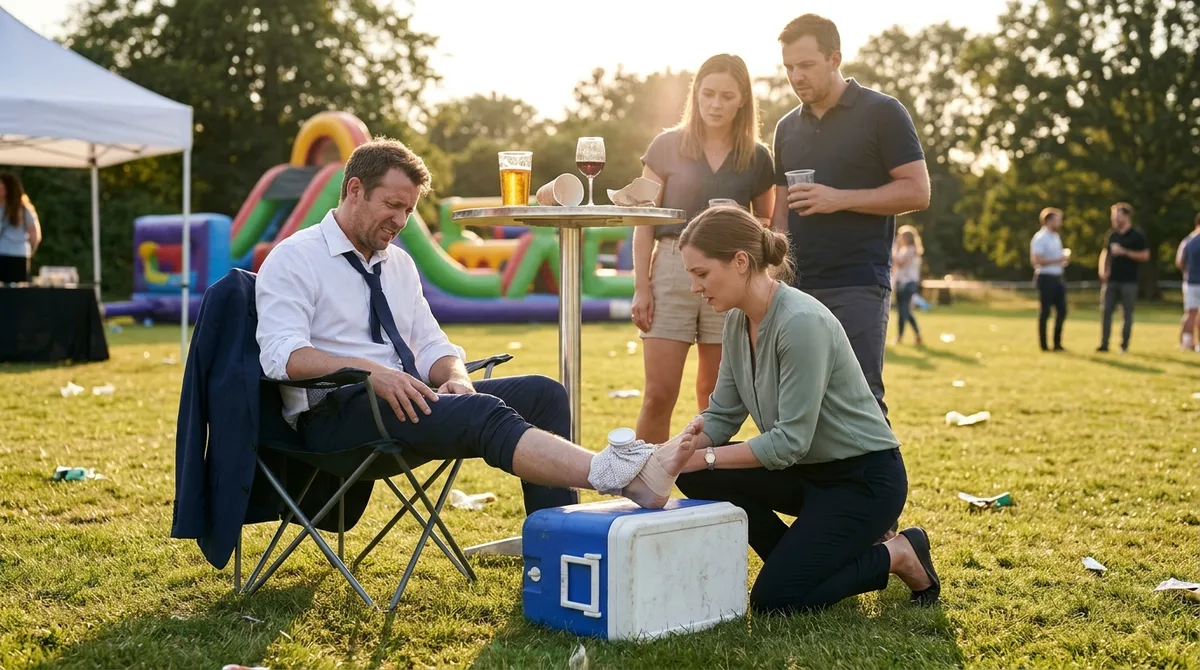
Recreational and social activities are treated more narrowly than job-related training, and alcohol service can complicate the analysis further. Florida is the clearest example. Under Florida Statutes § 440.092(1), recreational or social activities are not compensable unless they are an expressly required incident of employment and produce a substantial direct benefit beyond the usual improvement in employee health and morale.
Sports tournaments, laser tag sessions, and parties therefore face closer scrutiny than a required safety training course or a sales workshop. Training has an obvious work purpose, while a basketball game or a dance party may look like enjoyment that happens to be paid for by the employer. Decision-makers usually ask what the activity taught, sold, or improved for the business, not only whether employees had fun.
Alcohol adds another layer. When drinks are served, the review may shift from the event itself to the employee’s own conduct, including whether drinking contributed to the injury. Relevant details can include whether the employer provided the drinks, whether staff were expected to stay for the bar portion, and whether the injury happened during a task the employer assigned or during personal activity.
An employer-sponsored activity does not automatically qualify, even when it appears on the company calendar. Required participation and a clear business purpose matter most. A catered lunch followed by optional games offers much weaker support than a mandatory client-facing event with a written agenda.
Can an Injured Worker Also Bring a Personal Injury Claim?
Yes, an injured worker may be able to bring a personal injury claim against a third party. Whether a claim against the employer is possible depends on the state and the facts. A venue operator, an event catering company, a contractor that built a stage, or a provider of rented equipment such as an inflatable obstacle course may owe guests a duty of care, and a worker may pursue a separate civil claim against that party.
Employer negligence still matters, though in a different way. Hazard control at the event, such as keeping walkways clear, anchoring a tent, or supervising a rented ride, can shape both a third-party claim and any civil question about who was responsible. Records showing who chose the vendor, who inspected the site, and who handled safety complaints can be important.
Waiver and release agreements deserve careful review. Many events ask guests to sign a waiver before an activity begins, but a waiver signed before a recreational event may not control workers’ compensation rights. Courts in different states treat these documents differently. Some waivers are enforced, while others are limited to certain risks or set aside when their language is unclear.
Because the answer depends on the state, the facts of the event, and the parties involved, readers should speak with a licensed attorney about whether a separate claim is possible.
Which State Rules Could Change the Outcome?

Location can change the outcome because each state writes its own test, and decision-makers apply it to the facts differently. Florida limits recreational and social activities to those an employer expressly requires, a narrower standard than many readers expect. New York instead asks whether the injury arose out of and in the course of employment, so the focus stays on the link between the event and the job.
North Carolina and Virginia reached opposite results on the same core question. The North Carolina court upheld coverage where attendance at the conference was required, while the Virginia commission denied benefits for a voluntary tournament.
Some rules do not depend on how an event is classified. In Texas, an injured employee generally must report the injury to the employer within 30 days and file a claim with the Division of Workers’ Compensation within one year to protect the right to benefits.
Delaware sets its own clock. Employers there must submit a First Report of Occupational Injury or Disease within 10 days after being notified of an employee’s injury, so the report does not wait until the question of coverage is settled.
Before relying on any comparison, check these items for your state:
- the workers’ compensation statute, including any provision on recreational or social activities
- recent commission and appellate decisions involving similar events
- the reporting and filing deadlines that apply
What Reporting Steps and Deadlines Apply After an Event Injury?
Report the injury to the employer right away and start a written record, because some deadlines run before anyone decides whether the event counts as work-related. Texas generally requires an injured employee to report the injury to the employer within 30 days and to file a claim with the Division of Workers’ Compensation within one year to protect the right to benefits. In Delaware, the employer must submit a First Report of Occupational Injury or Disease within 10 days after being notified. Federal rules place separate duties on the employer. Under federal OSHA reporting rules, a work-related fatality must be reported within 8 hours, and an inpatient hospitalization, amputation, or loss of an eye must be reported within 24 hours. Under 29 CFR Part 1904, many employers with more than 10 employees must keep records of recordable work-related injuries and illnesses, although certain industries are exempt. Workers can ask whether their event injury appears on the employer’s injury log. Documentation carries the most weight in the early days. Workers who want a clear record should take these steps in order:
- Report the injury to a supervisor in writing, noting the date and time.
- Write down the event date, schedule, location, and the name of the person who organized it.
- Record whether attendance was required or expected, and save invitations, manager emails, and sign-in sheets.
- Keep any texts, chat posts, or messages that mention attendance.
- Collect the names and phone numbers of witnesses while details are still fresh.
- Photograph the scene, walkways, signage, and any equipment involved.
- Request a copy of the injury report the employer files.
- File the claim with the state workers’ compensation agency before the deadline that applies.
Taking the Next Step After an Event Injury
Start by identifying which test your state applies. Pull your state’s workers’ compensation statute and look for any provision on recreational or social activities, since Florida and Illinois show how much that wording can change the result. Then compare your facts against the three questions covered above: whether attendance was required, whether the employer controlled or benefited from the event, and whether the injury happened on the clock or during work-related travel.
Next, write a one-page timeline while your memory is fresh. List who asked you to attend, what tasks you were given, whether you were paid for those hours, and where you were injured in relation to the venue and your route home.
Then speak with a licensed workers’ compensation attorney in your area. This site cannot review your personal facts, but an attorney can read the actual invitation, emails, and sign-in records and advise whether a workers’ compensation claim, a separate claim against a venue or equipment vendor, or both should be pursued. Bring your timeline and every document you saved.
Do not wait for a coverage decision before acting on deadlines. Confirm your state’s reporting and filing windows now, and file on time even if the employer disputes that the event was work-related.