
An unexplained fall rule determines whether a worker who falls for no identifiable reason can still receive workers’ compensation benefits. The answer depends on the jurisdiction. Under the federal FECA guidance for federal employees, an unexplained fall during performance of duty is generally compensable unless evidence establishes a personal, non-occupational cause. Most states do not apply that default so simply, which is why the same fall can produce different outcomes across state lines.
Connecticut shows the employee-friendly side of the split. In its 2025 Jasinski decision, the Compensation Review Board affirmed benefits for a worker who fell at a milling-machine workstation after reporting dizziness, because the employer did not rebut the presumption of compensability. Utah takes a narrower view when a personal condition is involved, requiring proof that a hard floor actually made the injuries worse.
Key Takeaways
- An unexplained fall with no established cause is generally treated as compensable, while an idiopathic fall tied to a personal medical condition requires the worker or employer to show how the job still contributed.
- Under federal FECA guidance, an unexplained fall during performance of duty is generally compensable unless evidence establishes a personal, non-occupational cause.
- Utah’s 2024 Ackley decision requires a worker injured in an idiopathic fall onto a hard floor to prove, as a factual matter, that the floor’s hardness made the resulting injuries worse.
- Workers who suffer an unexplained fall should report it to a supervisor as soon as possible, check the filing deadline in the workers’ compensation law of the state where the injury happened, and ask the treating doctor to note in writing whether any cause was identified.
- Key Takeaways
What Is an Unexplained Fall Under Workers’ Comp?
An unexplained fall is a fall whose cause is unknown, even to the employee who was there. The worker may remember stepping, turning or reaching, but cannot say why the body went down. An idiopathic fall is different. It is attributed to a personal, non-occupational medical condition, such as a heart rhythm disorder, a seizure or an inner-ear problem that causes dizziness.
The label matters because it determines who must produce evidence. A fall with no established cause is generally treated as compensable, and the Connecticut board in Jasinski applied that starting point. An idiopathic fall, by contrast, begins with a personal cause, so the worker or employer must show how the work still contributed. That makes classifying the fall the first issue in many disputes, often before anyone debates how dangerous the job was.
Classification is usually decided from medical evidence. Records of a diagnosed condition, a documented episode of dizziness or fainting, or test results showing a physical cause can move a fall toward the idiopathic side. When the medical record is silent, the fall stays unexplained.
A worker who cannot say what happened can still have a claim, because not knowing the cause is not the same as proving a personal one. The inquiry then turns to whether the fall occurred during work and whether the workplace, such as a hard floor, a stairway or a machine station, contributed to the fall or to the injuries. Coworker statements, supervisor reports and a description of the worker’s daily tasks can fill gaps that the worker’s memory leaves open.
How Does Federal FECA Guidance Treat Unexplained Falls?

Under federal FECA guidance, an unexplained fall that happens during performance of duty is compensable unless evidence establishes an idiopathic cause. The guidance uses the same two categories described above. An unexplained fall has a cause that is unknown even to the employee, while an idiopathic fall is caused by a personal, non-occupational pathology. Because the classification determines the outcome, the default favors the injured federal worker.
Whether a fall is idiopathic or unexplained is usually determined from medical evidence. Claims examiners do not stop there, however. They are directed to examine whether a work hazard or special condition contributed to the injury beyond the immediate supporting surface. In practice, that means looking past the fact that the worker landed on a floor, stair or walkway and asking whether something about the job made the fall more likely or the resulting injuries more serious.
Consider a federal employee who slips while carrying boxes down a stairwell and cannot explain why her feet gave way. If her medical file shows no diagnosed condition, the fall remains in the unexplained category, and the focus shifts to what the stairwell and the task contributed. Supervisor notes on how often she used those stairs, how loaded she was, and whether the handrail and lighting were in working order can all shape that inquiry.
Federal claimants should also understand that the default is not automatic. Medical records that document a seizure, fainting spell or inner-ear disorder can move the claim toward the idiopathic side, and then the evidence about the workplace carries more weight. Gathering witness statements and a clear description of daily duties early helps the examiner see the full picture.
Why Do State Decisions Disagree on Unexplained Falls?
States disagree because each one decides how much weight the unexplained label carries. Some begin from a presumption in the worker’s favor, while others require the worker to connect the fall to the job. Connecticut sits at the employee-friendly end. Its Compensation Review Board affirmed benefits for a worker who fell at a milling-machine workstation after reporting dizziness. The medical reports did not establish a medical cause, and the employer did not rebut the presumption of compensability. The board also cited the state Supreme Court’s observation that unexplained-fall injuries are compensable in a majority of jurisdictions.
The board kept unexplained falls separate from idiopathic falls, which begin with an established personal cause such as a diagnosed condition. Once a personal cause is documented, the presumption no longer carries the claim, and the dispute shifts to the workplace.
Other courts start somewhere else. The North Carolina Court of Appeals held in a 2001 case that an unexplained fall supports an award only if the Commission finds that falling while grading boards was a risk or hazard incident to the worker’s employment. The court also declined to extend a death-case presumption to the surviving worker’s claim.
Illinois takes a comparative approach to stairs. The appellate court in Rund required the commission to consider whether the worker faced the common risk of falling on stairs more often than the general public. Her job required climbing the stairs up to 15 times a day, so that frequency mattered to the analysis.
Can a Hard Floor Turn an Idiopathic Fall Into a Claim?
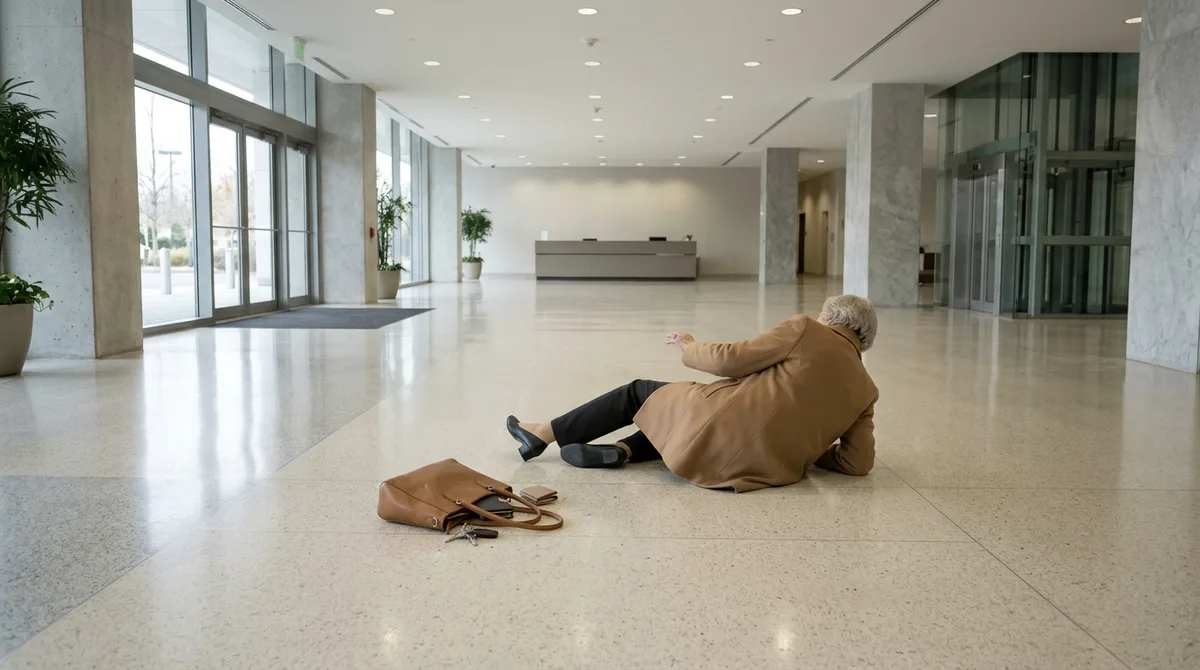
A hard floor can support a claim after an idiopathic fall, but only if the worker proves the surface made the injuries worse. In Utah’s 2024 Ackley decision, the Court of Appeals addressed an idiopathic fall onto a level hard floor, where a personal medical condition started the fall. The court held that such a claim may be compensable only if the worker proves, as a factual matter, that the floor’s hardness made the resulting injuries worse.
The bar is set high. Showing that a hard floor carries a greater general risk of injury than a softer one is not enough. The worker must link the hardness to the actual harm, which means evidence about what the body struck and what damage followed.
Consider two workers who both lose consciousness from a heart rhythm problem at the same workstation. One lands on carpet and bruises a forearm. The other strikes concrete and suffers a skull fracture. Only the second worker has a realistic path to showing that the surface changed the outcome, because the injury itself carries much of the proof.
The practical lesson is that injury severity and the surface involved become the central evidence in idiopathic cases. A worker should keep the incident report describing the floor material, photographs of the spot where the fall happened, and medical records that document each injury. Coworker statements about where the head or hip hit the floor can tie the surface directly to the harm.
Does a Work Risk Have to Be Shown?
In North Carolina and Illinois, the worker generally has to show that the job itself created or increased the fall risk, rather than relying on the fall being unexplained. These courts sit between Connecticut’s presumption in the worker’s favor and Utah’s focus on how much a hard surface worsened the injuries.
In North Carolina, the Court of Appeals decided a 2001 case, Janney v. J.W. Jones Lumber Company. The court held that an unexplained fall could support an award only if the Commission found that falling while grading boards was a risk or hazard incident to the employment. It also refused to extend a death-case presumption to the claim of the surviving worker, so that worker had to make the work connection directly.
Illinois asks a comparative question. The appellate court held that the commission had to consider whether the worker faced the common risk of falling on stairs more often than the general public. The record showed that the job required traversing the stairs up to 15 times a day, and that repeated exposure was central to the comparison.
For a worker in a similar position, the practical step is to document how the job put you on the hazard. Note how many trips a stairway required in a shift, what you carried, and which tasks, such as grading boards, brought you to that spot. Timekeeping entries, route sheets and a coworker who saw the routine can show frequency in a way that memory alone cannot.
What Evidence Helps Prove a Work-Connected Fall?

Boards and examiners look at six kinds of evidence: the medical file, witness accounts, the worker’s actual duties, workplace conditions, whether those conditions contributed to the fall or the injuries, and how quickly the worker reported it. Gathering these early helps show which side of the idiopathic line a fall belongs on.
- Medical records that state whether a cause was found or ruled out, including normal test results and any notes about dizziness or fainting before the fall.
- Witness accounts of what the worker was doing in the minutes before the fall and how the area looked before and after it.
- Job descriptions, shift logs and route sheets showing repetitive movements, stair climbs, ladder use or equipment handling.
- Conditions such as wet or polished floors, poor lighting, cords or boxes left in walkways, and equipment the worker had not used before.
Medical records carry the most weight on classification, so the worker should ask the treating doctor to note in writing whether any cause was identified. A record that says the cause remains unknown is as useful as one that names a diagnosis.
Witnesses fill gaps that a worker’s memory may leave. A coworker who saw the route, the load being carried or the condition of the floor can describe details that the injured person may not recall after a head injury or a shock.
Conditions matter most when they explain the fall or make the injuries worse. A photograph of the spot, a note of the lighting level and a description of the footwear and handrail at the time can connect a workplace feature to the outcome.
Prompt reporting protects every other item on the list. Tell the employer as soon as possible, and write a statement while the details are fresh. Include the time, the location, the task, what you were holding, and any symptoms you felt just before going down.
What Do Workplace Falls Cost, and What Do the Numbers Not Show?
Workplace falls are a large and expensive problem in the United States. The National Safety Council reports an average of $57,314 for lost-time claims caused by falls or slips from accidents in 2023 and 2024.
The National Institute for Occupational Safety and Health reported that 805 workers died from falls in 2020. That same year, 211,640 private-industry workers suffered severe fall injuries that required days away from work. The agency also estimates that workers’ compensation and medical expenses tied to workplace falls total $70 billion a year.
These totals describe the problem across the whole workforce. They show how often falls happen, how often they cause lost time, and how much they cost. They do not show whether any individual fall is covered. A claim turns on the facts of that worker’s case: whether the fall is classified as unexplained or idiopathic, what the medical file says, and whether the job or the workplace contributed to the fall or to the injuries.
A national average can tell a worker that falls are common, but it cannot tell a board how to decide one claim. Examiners and boards look at the shift log, the condition of the floor or stairway, and the treating doctor’s notes. Those records apply to one fall, and they are the material that determines the outcome.
When Should You Act After an Unexplained Fall?

Report the fall to a supervisor as soon as possible, then find out which filing deadline applies to your claim. Deadlines are set by each state’s workers’ compensation law and can differ widely, so the rule to check is the one in the state where the injury happened.
Some deadlines can be affected by rules on when the injury was discovered or on delays in filing. A worker who did not realize right away that the fall caused lasting harm may face a different timeline than one who knew at once. Questions about discovery and delay should be checked with a qualified professional rather than assumed.
Keep copies of all paperwork from the start. Save the incident report, every medical record and bill, the treating doctor’s note on whether a cause was identified, and any written statement you gave the employer. Write down the name of the supervisor you told and the date you told them.
Consider consulting a workers’ compensation attorney when the employer or insurer disputes how the fall happened, questions whether it occurred at work, or denies the claim. Those disputes usually turn on the medical file and the workplace evidence that decides classification. An attorney can help organize that record before a hearing or appeal deadline arrives.
Next Steps After an Unexplained Workplace Fall
Start with the document that will shape everything else: the treating doctor’s note on whether any cause was identified. Ask for it in writing before your next appointment, and ask the doctor to mention any dizziness, fainting spells or test results from the period before the fall.
Next, find the claim-filing deadline in the workers’ compensation law of the state where the fall happened. If you are a federal employee, your claim runs through the federal process instead, so confirm which system covers you before you do anything else.
Write a timeline while your memory is fresh. Include the time, the exact spot, the task you were doing, what you were carrying, and how the floor, stairway or machine station looked. Sign and date it, and keep a copy. Then ask any coworker who saw the fall or the route to write a short account of what they observed.
If the employer calls the fall personal, disputes that it happened at work, or denies the claim, that is the point to speak with a workers’ compensation attorney. Bring the timeline, the medical notes, the incident report and the coworker accounts to that first meeting, so the attorney can see the evidence that decides how the fall is classified.
Frequently Asked Questions
1. Can I still get benefits if I did not report the fall right away?
Late reporting can complicate a workers’ compensation claim and can affect filing deadlines. The rules on notice and delay differ from state to state, and some states consider when the injury was discovered. Report the fall as soon as possible and check the timing rules in the state where it happened.
2. Does a dizzy spell or fainting episode automatically rule out a claim?
No. A dizzy spell or fainting episode can move a fall toward the idiopathic side, but it does not end the claim on its own. In Connecticut’s Jasinski decision, the worker had reported dizziness and still received benefits because the medical reports did not establish a medical cause.
3. Who decides whether my fall is idiopathic or unexplained?
The workers’ compensation board, commission or claims examiner handling the case makes that decision. It usually rests on medical evidence, such as diagnosis records, test results and doctors’ notes about dizziness or fainting. Witness accounts and workplace conditions can also shape the outcome, especially when the fall is treated as idiopathic.
4. What if the fall happened during a break or off the clock?
A fall during a break or off the clock is harder to bring under workers’ compensation, because most systems require the injury to occur in the course of employment. Whether a break counts often depends on whether it was paid, whether the employer allowed it and whether you were on the premises for work purposes. Keep time records and any written statement showing where you were and why you were there.
5. Do I need a lawyer to file a claim for an unexplained fall?
No lawyer is required to file a workers’ compensation claim for an unexplained fall, and many workers report the injury and file on their own. A lawyer becomes more useful when the employer or insurer disputes how the fall happened, questions whether it occurred at work or denies the claim. In those cases, an attorney can help organize the medical and workplace evidence before a hearing or appeal.
6. How can I find my state’s filing deadline for a workplace injury?
Look up the workers’ compensation statute in the state where the fall happened, or check that state’s workers’ compensation agency website. Deadlines are set by each state’s law and can differ widely, so do not rely on a rule from another state. If you are unsure, ask a workers’ compensation attorney to confirm the deadline before it passes.